Quick Summary
- Severe frost damage to grass occurs when frozen leaf cells are physically crushed by foot traffic, equipment, or heavy winter debris.
- Sub-zero temperatures freeze the water within grass foliage; walking on frosted lawns shears cell membranes and creates black, dead footprints that persist into spring.
- Implementing proper cold-weather protocols—such as keeping off frozen swards, clearing autumn leaves, and avoiding late-season scalping—protects your turf crowns from irreversible freeze-thaw stress.
- Repairing damaged patches requires hollow-tine aeration, scarifying dead thatch, top-dressing with BS3882 screened loam, and overseeding once soil temperatures hit 10°C.
- Turf Supplies Essex provides top-quality natural grass turf rolls with delivery & installation services, including landscaping materials like topsoil & wood chippings, helping domestic and trade gardens across Essex, East London, and North London stay healthy year-round.
Introduction
Winter in the East of England brings a deceptive kind of beauty. A crisp, sunny morning with hoar frost sparkling across your lawn looks picture-perfect on a postcard, but under the surface, your turf is in its most vulnerable biological state. When temperatures drop below freezing, individual grass plants undergo immense cellular strain. If handled incorrectly, ordinary morning routines—such as hanging out the washing, walking the dog, or wheeling a garden bin across the lawn—can cause catastrophic, irreversible frost damage to grass. Instead of a vibrant green carpet waiting to wake up in spring, you are left with bruised, blackened footprints, thinning patches, and opportunistic winter moulds. Understanding the underlying science of frozen turf and adapting your maintenance routine ensures your garden emerges intact once the thaw arrives. Serving the region as a trusted provider of top-quality natural grass turf rolls with delivery & installation services, including landscaping materials like topsoil & wood chippings, Turf Supplies Essex helps homeowners build, protect, and restore lawns that withstand the harshest regional winters.
Worried that winter frost or ice has damaged your lawn? Tap the WhatsApp button to chat directly with our Essex turf specialists for fast, tailored recovery advice :
The Biological Reality: What Freezing Weather Does to Lawn Grass
To avoid frost damage to lawns, gardeners must first understand what is happening inside the plant itself. Cool-season turf grasses—predominantly perennial ryegrass, creeping red fescues, and meadow grasses—are adapted to withstand cold weather by slowing their metabolism and entering a state of dormancy once soil temperatures drop below 5°C.
[ FROST DAMAGE CELLULAR MECHANISM ]
foliage stays healthy and intact.
leads to cellular death, black bruises.
Grass blades consist of more than 80% water. During a hard frost:
- Water both inside and between the plant cells freezes into microscopic, razor-sharp ice crystals.
- In an undisturbed lawn, this ice formation is natural; as the morning sun rises, the ice crystals gradually melt, and the cells reabsorb moisture without structural damage.
- However, when external weight—such as a footstep or mower wheel—is applied to frozen foliage, the ice crystals act like miniature blades. They tear through brittle cell walls and rupture the internal cell membranes.
- Once the leaf tissue is crushed while frozen, it cannot repair itself. As it thaws, the fluid leaks out, resulting in the rapid death of the top growth.
Recognising the Warning Signs of Frost-Damaged Grass
Homeowners often fail to notice the consequences of cold-weather abuse immediately. The true signs of frost-damaged grass usually develop between 24 and 72 hours after the initial freeze-thaw cycle:
- Dark, Bruised Footprints: Distinct silhouette marks or track marks where people or pets walked across the frost. Initially appearing dark green and water-soaked, they quickly turn purple-brown, then straw-coloured and dead.
- Bleached, Brittle Leaf Tips: Individual grass blades develop frayed, pale white or straw-coloured tips. This occurs when cold winds desiccate foliage that cannot pull up replacement water from frozen subsoil.
- Fusarium Patch (Pink Snow Mould): Circular patches of collapsed, slimy, or bleached grass, often fringed with a pale pink or white fungal web. Snow mould frequently attacks lawns weakened by frost compaction or covered by wet snow drifts.
- Frost Heave Crown Separation: In wet, poorly drained soils, repeated freezing and thawing expands water volumes underground. This physical expansion heaves the soil surface upward, tearing the roots away from the crown of the plant and leaving it loose and desiccated.
4 Critical Rules: How to Prevent Frost Damage to Grass
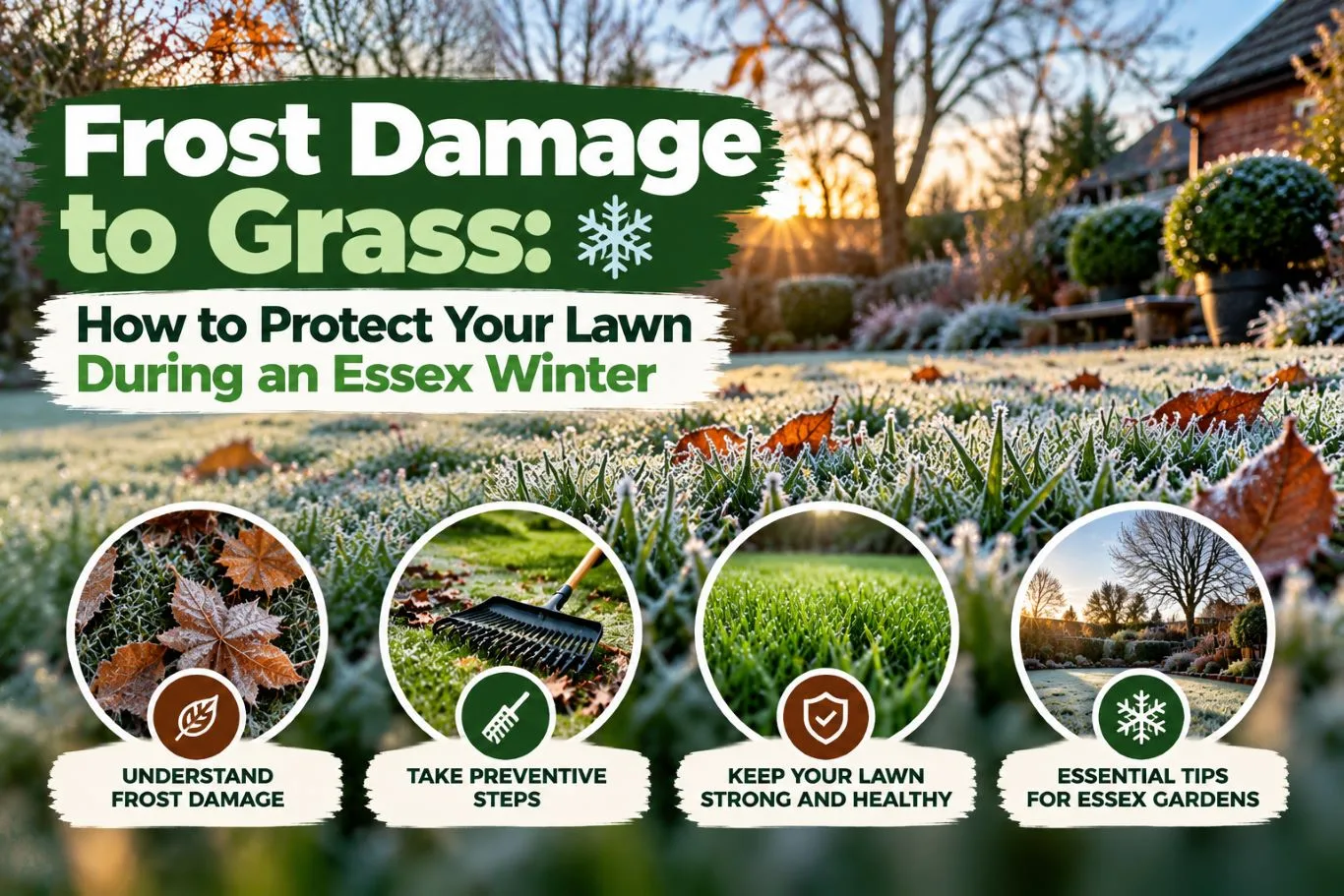
Adopting sensible frost-resistant lawn care tips prevents avoidable lawn devastation throughout the cold months:
| Cold-Weather Hazard | Turf Impact | Preventative Action |
|---|---|---|
| Walking on Frozen Turf | Fractures brittle leaf cells | Strict “keep off” protocol |
| Wet Leaf Carpets | Chokes light & traps humidity | Weekly raking with spring tines |
| Scalping in Late Autumn | Exposes crown to windchill | Raise mower deck to 45mm–50mm |
| Heavy Snow Compaction | Spreads Fusarium fungal mould | Avoid piling snow on grass edges |
1. Enforce a Strict “Keep Off” Policy
The simplest rule of protecting turf during winter is keeping off frosted or frozen grass. Stay off the lawn whenever white rime or ice is visible on the leaf blades. Instruct family members to use paved garden walkways, and lay down temporary wooden scaffold boards if crossing the lawn to reach an oil tank, shed, or compost heap is unavoidable.
2. Remove Wet Autumn Leaves Continuously
Never allow a sodden blanket of fallen autumn leaves to sit over your grass during freezing spells. Trapped beneath wet leaves, the grass receives zero photosynthetic light. The decomposing leaf layer creates a dark, damp micro-climate that acts as an incubator for fungal spores, drastically lowering the plant’s natural frost tolerance. Use a lightweight spring-tine rake or battery leaf blower once a week when the lawn is dry.
3. Maintain High Cutting Clearance Before Winter Sets In
When carrying out final autumn cuts, resist the temptation to scalp the turf short. Taller grass blades (cut to a height of 45mm to 50mm) act as a natural thermal duvet, trapping air pockets around the lower plant crown and insulating the root plate from penetrating ground frost. Scalping exposes the crown to direct windchill and winter desiccation.
4. Manage Snowfall Without Creating Ice Slabs
A light, natural covering of snow actually insulates the ground from bitter Arctic gales. However, you should never trample snow into hard-packed ice slabs. When clearing patios, driveways, or public paths, avoid shovelling deep mounds of heavy, salt-laden snow onto your lawn perimeter, as the compacted weight blocks air and suffocates the turf beneath.
Winter Lawn Care in Essex: Tackling Regional Clay Challenges
Managing a garden across Essex and London presents specific environmental challenges due to our regional geology. Heavy London clay is widespread across the region, which significantly affects winter lawn maintenance UK routines.
[ SOLVING POOR WINTER DRAINAGE ]
Compacted Clay Topsoil –> Spike / Hollow-Tine (100mm Depth) –> Brush Coarse Sand
(Holds surface rain) (Opens vertical fissures) (Restores root oxygen)
Clay soil holds water exceptionally well. When heavy winter rainfall meets freezing temperatures, the trapped moisture expands within the topsoil, choking off oxygen and leading to anaerobic waterlogging. To protect your grass:
- Relieve Surface Compaction in Autumn: Before the first hard frosts arrive in November, aerate your lawn using a garden fork or mechanical hollow-tiner. Spiking holes to a depth of 100mm to 150mm allows surface pooling to drain into subsoil layers.
- Top-Dress with Coarse Sand and Loam: Brushing a free-draining mix of sharp sand and BS3882 screened topsoil into the aeration holes creates permanent drainage channels, keeping the root zone drier and far less susceptible to deep freezing.
Step-by-Step Guide: Repairing Frost-Damaged Lawns in Spring
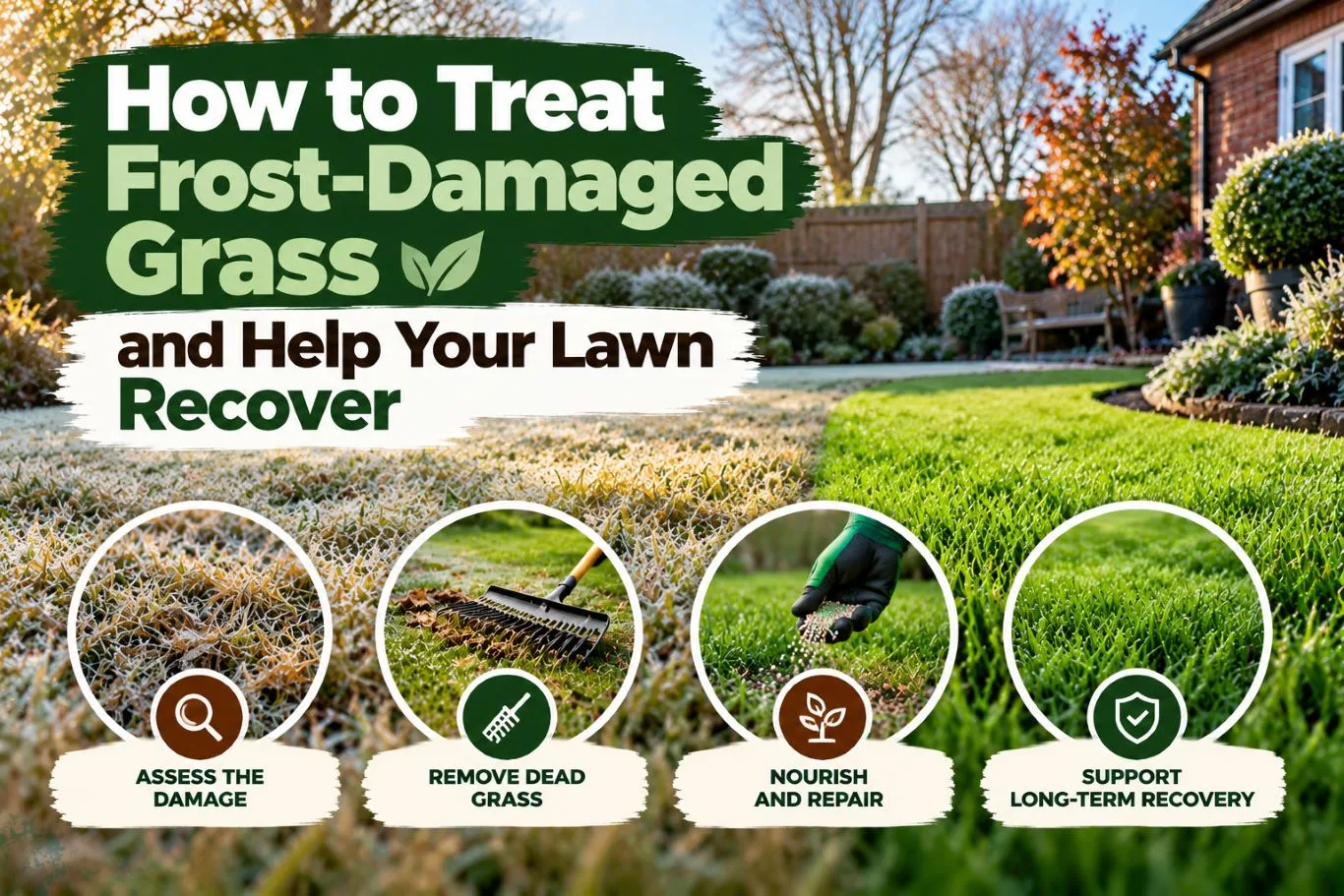
If cold weather and accidental foot traffic have left your lawn marked with dead tracks or bare patches, don’t despair. Follow this reliable restoration roadmap once temperatures consistently rise above 10°C in spring:
[ SPRING REPAIR PROCESS ]
[ 1. Rake Out Dead Thatch ] –> [ 2. Decompact Soil Core ]
Remove straw-coloured debris Spike with fork to aerate
| |
v v
[ 3. Overseed & Top-Dress ] –> [ 4. Roll & Hydrate ]
Apply grass seed & loam Consolidate contact & water
- Rake and Scarify the Dead Tissue: In late March or April, use a wire spring-tine rake to comb through blackened or straw-coloured patches. Clearing away dead, desiccated leaves exposes the underlying bare earth and allows warming sunlight to reach the crowns.
- Decompact the Soil Core: Heavily trodden frost tracks often suffer from severe localized compaction. Use a hand fork to spike the damaged zone to a depth of 100mm, gently wiggling the tines to open up the soil bed.
- Overseed with Resilient Cultivars: Scatter a high-germination overseeding mix containing dwarf perennial ryegrass and strong fescues over the bare spots at a rate of 25g to 35g per square metre.
- Top-Dress with Screened Soil: Cover the seed with a 5mm to 10mm layer of 10mm Agriculture Screened Premium Grade Top Soil. This protects seeds from foraging birds, locks in surface moisture, and levels out any depressions left by footmarks.
- Roll and Keep Moist: Lightly press the seed and soil down using the back of a shovel or lawn roller to guarantee positive seed-to-soil contact. Keep the repaired patch moist with light, daily misting until the new green shoots establish.
FAQs Section
1. Will grass damaged by frost grow back on its own?
If only the top of the leaf blade was scorched or damaged by light frost, the lawn will naturally push up fresh green growth from the crown once spring temperatures warm up. However, if the crown itself was crushed by heavy footsteps while frozen solid, that individual plant is dead and the bare patch will require raking, overseeding, or re-turfing.
2. Can I apply lawn fertiliser during a cold, frosty spell?
No. Never apply standard high-nitrogen fertilisers during freezing winter weather. Nitrogen encourages soft, succulent foliar growth that possesses zero frost tolerance and dies instantly in cold temperatures. If you must apply an autumn/winter lawn feed, choose an iron- and potassium-rich formula before frosts set in; potassium strengthens inner cell walls against freezing, while iron hardens the sward against fungal pathogens.
3. Can fresh turf rolls be laid during winter in Essex?
Yes, as long as the ground is not frozen solid or waterlogged. Winter is actually an effective season for lawn installation because the soil remains naturally moist, virtually eliminating the need for constant irrigation. Once laid, the turf establishes its root network quietly over winter, preparing for strong spring growth.
4. Which areas across Essex and London do your delivery vehicles cover?
We offer prompt, reliable delivery across the entire county of Essex, East London, and North London, regularly supplying domestic and commercial projects in Chelmsford, Brentwood, Romford, Chigwell, Epping, Loughton, and Enfield.
5. How quickly can you deliver turf rolls and screened topsoil during winter?
We operate our own regional distribution fleet and maintain stock year-round. We consistently deliver fresh cultivated grass rolls, 1-ton bulk bags of screened topsoil, and natural wood chippings within 24 to 48 hours of order confirmation, subject to safe ground conditions.
Final Thoughts: Shield Your Lawn for a Thriving Spring
An enviable summer lawn is not created solely in the spring; it is preserved through attentive, defensive care during the coldest months of the year. By respecting the fragile cellular state of frozen grass, keeping foot traffic strictly off frosty swards, managing heavy clay drainage, and clearing away damp leaf blankets, you eliminate the primary causes of frost damage to grass. Taking these simple precautions ensures your garden stays healthy and resilient through winter, ready to transform into a thick, emerald-green showpiece as soon as the warmer weather arrives.
When you need farm-fresh turf rolls, nutrient-rich screened topsoil, or professional landscape laying, count on Turf Supplies Essex. Providing top-quality natural grass turf rolls with delivery & installation services, including landscaping materials like topsoil & wood chippings, our experienced local team provides properties across Essex, East London, and North London with the high-grade supplies and practical advice needed to keep outdoor spaces looking their best year-round. Contact our friendly specialists today to schedule your winter deliveries or plan your upcoming garden projects.