
Quick Summary
- Effective lawn moss control before turfing is essential to prevent spores from suffocating your new grass rolls from beneath.
- Moss is a symptom of underlying soil issues, such as poor drainage, high acidity, or extreme compaction.
- Simply laying new turf over mossy ground will result in failure; the root cause must be mechanically and chemically addressed first.
- Improving soil health through aeration and pH balancing creates an environment where grass thrives and moss cannot survive.
- Turf Supplies Essex provides professional natural grass turf with delivery & installation services, ensuring your new lawn is built on a clean, moss-free foundation.
Introduction
There is a common misconception in garden renovation that simply “covering up” a mossy, damp lawn with fresh rolls of grass will solve the problem. Unfortunately, moss is an incredibly resilient opportunist. If you don’t implement rigorous lawn moss control before turfing, you are essentially building a house on a crumbling foundation. Within a few seasons, those tiny spores will find their way back to the surface, out-competing your new grass and leaving you back where you started. To achieve a truly professional, long-lasting finish, you must treat moss as a symptom of a deeper soil issue rather than just a surface nuisance. At Turf Supplies Essex, we specialise in providing natural grass turf with delivery & installation services across the county, and we always advise our clients that the secret to a moss-free future lies in the preparation work completed before the first roll is ever unrolled.
Tired of moss taking over your garden? Message us on WhatsApp for a free quote on a fresh, moss-free lawn :
Understanding the Enemy: Why Moss Appears
Moss doesn’t have roots in the traditional sense; it uses tiny hair-like structures called rhizoids to anchor itself. It thrives in conditions where “higher” plants, like lawn grass, struggle to survive. If your Essex garden currently looks more like a green sponge than a lawn, it is usually due to one of four factors:
- Poor Drainage: Essex clay is notorious for holding water, creating the damp, anaerobic conditions moss loves.
- Compacted Soil: Heavy foot traffic squashes the air out of the soil, making it impossible for grass roots to breathe.
- Low Soil pH: Acidic soil (below pH 6.0) inhibits grass growth but acts as a fertiliser for moss.
- Excessive Shade: Most grass varieties need significant UV light to photosynthesise, whereas moss can flourish in the dimmest corners of a north-facing garden.
Phase 1: Chemical and Mechanical Eradication
The first step in lawn moss control before turfing is to kill the existing growth. If you simply dig it up while it is alive, you risk spreading millions of microscopic spores across your newly prepared topsoil.
Chemical Treatment
Apply a high-quality moss killer (often based on ferrous sulphate) to the entire area. You will know it is working when the moss turns a dark, charred black. This process usually takes 7 to 14 days. Once the moss is dead, it becomes brittle and far easier to remove.
Scarification
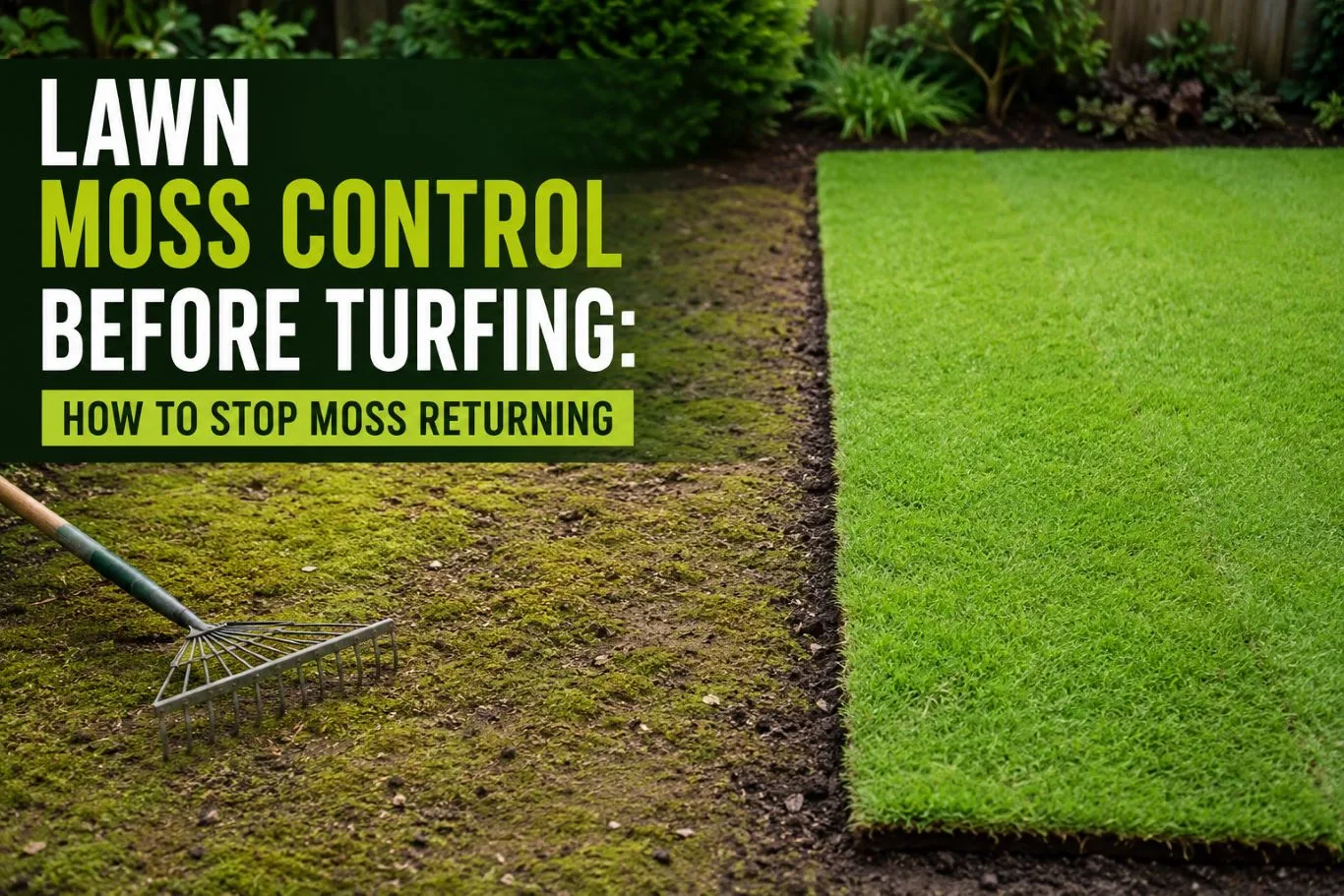
Once blackened, the dead moss must be physically removed. For small areas, a spring-tine rake will suffice, but for most residential gardens, we recommend a mechanical scarifier. This machine effectively “combs” the soil, pulling the dead thatch and moss out of the ground. Be prepared—the amount of debris removed can be staggering, often leaving the garden looking like a brown wasteland. This is a good sign; it means you’ve cleared the way for your new turf to make direct contact with the soil.
Phase 2: Addressing Soil Structure and Drainage
Now that the moss is gone, you must fix the environment that allowed it to grow in the first place. If you skip this stage, any natural grass turf with delivery & installation services will only be a temporary fix.
Deep Aeration
Compaction is a primary driver of moss. Using a hollow-tine aerator to remove small plugs of soil allows air, nutrients, and water to reach the root zone. In heavy clay areas like Chelmsford or Basildon, following aeration with a “top dressing” of sharp sand or grit can permanently improve the soil structure, making it far less hospitable to moss.
Rotavating and Improving the Bed
For a total lawn overhaul, rotavating the soil to a depth of 150mm is the gold standard. This breaks up the hard pan of the earth and allows you to incorporate organic matter. This is also the ideal time to add a “pre-turf” fertiliser. By creating a nutrient-rich, well-drained bed, you give your new grass the competitive advantage it needs to “out-grow” any dormant moss spores.
Phase 3: The Role of Soil pH
Grass thrives in a slightly acidic to neutral pH (around 6.5). If your soil is too acidic, moss will always have the upper hand. Before laying your new turf, use a simple soil testing kit. If the result is below 6.0, adding garden lime (calcium carbonate) can help neutralise the acidity. This simple adjustment to the soil chemistry is a powerful, long-term form of moss control that many homeowners overlook.
Choosing the Right Turf Variety
Sometimes, despite your best efforts at lawn moss control before turfing, the shade in your garden remains a fixed reality. In these cases, the choice of turf is your final line of defence. If you lay a sun-loving ryegrass in a shaded corner, it will inevitably thin out, leaving gaps for moss to fill.
At Turf Supplies Essex, we offer specialised shade-tolerant varieties. These blends are composed of fescues that are biologically adapted to low-light conditions. By matching the grass variety to your garden’s specific light levels, you ensure a dense sward that physically blocks moss from establishing.
Professional Installation: The Final Barrier
A professional installation doesn’t just look better; it functions better. When our team handles your natural grass turf with delivery & installation services, we ensure that the seams are tightly butted together. This leaves no “naked” soil where moss spores can land and germinate. Furthermore, a perfectly levelled lawn prevents the small “puddles” or hollows where water collects—the exact spots where moss traditionally starts its comeback.
Maintenance After Turfing
Once the new lawn is down, the work of moss control transitions into maintenance.
- Don’t Scalp the Grass: Mowing too short stresses the grass and lets light reach the soil surface, encouraging moss. Keep your mower at a medium-high setting.
- Autumn Care: Every autumn, a light rake and an application of autumn fertiliser will strengthen the grass roots before the damp winter months.
- Leaf Removal: Never leave autumn leaves sitting on new turf. They block light and trap moisture, creating a “moss greenhouse” on your lawn.
Frequently Asked Questions
Q1: Can I just put weedkiller on the moss and lay turf the next day?
No. Most moss killers need time to work, and the dead organic matter must be removed. Laying turf over dead moss creates a barrier that prevents the new roots from reaching the soil, leading to “turf failure” where the grass stays yellow and eventually dies.
Q2: Is moss control a one-time job?
Think of it as an ongoing management strategy. By doing the heavy lifting of lawn moss control before turfing, you are setting yourself up for 90% less work in the future, but you will still need to maintain good drainage and aeration over the years.
Q3: Do you offer moss treatment as part of your installation?
We assess every site individually. As a reliable provider of natural grass turf with delivery & installation services in Essex, we can advise on the best course of action for your specific soil type and can include ground preparation and moss removal as part of our comprehensive service.
Q4: What is the best time of year to tackle moss?
Late spring and early autumn are the best times. This is when moss is actively growing (and thus more susceptible to treatment) and when the weather is ideal for laying new turf to take its place.
Q5: Does your service cover my area near Southend?
Yes, we cover all of Essex, including Southend, Rayleigh, and the surrounding areas. We pride ourselves on a fast, professional local response to ensure your turf arrives fresh and your ground is prepared correctly.
Conclusion: Investing in a Moss-Free Future
Achieving a flawless, emerald-green lawn in the UK requires more than just good luck; it requires a strategic approach to soil health. Implementing thorough lawn moss control before turfing is the only way to ensure that your new garden stays as beautiful as the day it was installed. By killing the existing moss, improving the underlying drainage, and adjusting the soil pH, you are creating a habitat where grass is the dominant species.
When you work with Turf Supplies Essex, you are choosing a partner that understands the nuances of the local landscape. Our commitment to providing premium natural grass turf with delivery & installation services means we don’t just sell you a product; we provide the foundation for a thriving outdoor space. Don’t let moss steal the spotlight from your new lawn—take control of your soil today and enjoy a garden that remains lush and resilient for years to come.
Looking to buy natural grass turf with installation services in Essex?