Quick Summary
- Established British lawns rarely require supplemental hydration during the colder months; watering lawn in winter is primarily dictated by rainfall patterns and seasonal grass dormancy.
- Adding excess water to cold, heavy soils suffocates turf roots, encourages anaerobic conditions, and dramatically increases the risk of fungal infections like fusarium patch and snow mould.
- Newly laid winter turf requires one thorough soaking immediately after installation to eliminate air pockets, after which natural precipitation and morning dew usually take over.
- The only critical exception for established lawns occurs during unseasonably dry, windy winter spells without rain, where light midday hydration prevents root desiccation.
- Turf Supplies Essex provides top-quality natural turf rolls with delivery & installation services, including landscaping materials like topsoil & wood chippings, supporting homeowners across Essex, East London, and North London with professional, season-appropriate turf care.
Introduction
Winter brings a quiet transformation to British gardens. As daylight hours dwindle and temperatures drop below 5°C, cool-season grasses such as perennial ryegrass and fescues transition into biological dormancy. Above-ground leaf growth comes to a near standstill, and transpiration rates decrease significantly. Yet, many well-intentioned gardeners wonder whether their lawn is drying out during prolonged dry spells or cold snaps. Understanding the exact science behind watering lawn in winter is essential to prevent costly garden mistakes. In the UK climate, over-saturating cold ground is far more hazardous than under-watering; excessive moisture on freezing soil displaces oxygen, rots fine root hairs, and fosters devastating winter lawn diseases. Serving the community with practical advice and premium products, Turf Supplies Essex provides top-quality natural turf rolls with delivery & installation services, including landscaping materials like topsoil & wood chippings, helping domestic and trade gardens across Essex, East London, and North London stay healthy throughout every winter season.
- Quick Summary
- Introduction
- The Biological Reality: Does Dormant Grass Need Water?
- When to Leave Your Lawn Alone: The Hazards of Winter Overwatering
- 1. Anaerobic Clay Conditions
- 2. Encouraging Fusarium Patch and Snow Mould
- 3. Frost Heave and Root Shearing
- When to Water Lawn in Winter: The Rare Exceptions
- 1. Extended Winter Drought with Bitter Winds
- 2. Watering New Turf in Winter
- Winter Lawn Watering Guide: Best Practice Rules
- Seasonal Care Matrix: How Often to Water Grass in Winter
- Comprehensive Winter Lawn Care Tips for UK Gardens
- FAQs
- Final Thoughts: Let Nature Handle Your Winter Lawn
Wondering if your lawn needs a drink during a cold dry spell or if you should leave it alone? Tap the WhatsApp button to get quick, tailored winter care advice from our professional team :
The Biological Reality: Does Dormant Grass Need Water?
To determine should you water your lawn in winter, you must understand how cool-season grasses interact with water in low temperatures:
Stomata Close & Foliage Enters Dormancy
- Near-Zero Transpiration: In summer, grass blades act like evaporative cooling towers, losing litres of water daily through their open stomata to cope with heat. In winter, these stomata remain closed, and relative humidity in the UK regularly exceeds 85%, reducing evaporative moisture loss to negligible levels.
- Reduced Metabolic Demand: Because the grass is not actively expending energy to produce new green shoots, its nutritional and water uptake drops to maintenance levels.
- Soil Moisture Retention: Low solar radiation, minimal evaporation, and heavy morning dews keep the top 50mm to 100mm of soil naturally damp for weeks at a time without a single drop of hosepipe water.
When to Leave Your Lawn Alone: The Hazards of Winter Overwatering
For 95% of UK gardens, the golden rule of winter lawn maintenance UK is to leave the hosepipe and watering can firmly in the shed. Forcing water onto winter lawns introduces severe agronomic risks:
| Winter Watering Hazard | Agronomic Consequence | Long-Term Damage |
|---|---|---|
| Soil Pore Saturation (Particularly on Essex Clay) | Liquid water displaces subsoil oxygen, causing anaerobic rot | Root dieback, yellowing crowns, and weak spring recovery |
| Water Freezing in the Root Bed | Moisture expands upon freezing, creating frost heave | Roots shear from crowns, leading to loose, desiccated turf |
| Lingering Foliar Moisture | Leaf blades stay wet for 48+ continuous hours | Rapid outbreaks of snow mould and fusarium patch fungal mycelium |
1. Anaerobic Clay Conditions
Essex, North London, and East London are largely situated on dense London clay subsoils. Clay particles are microscopic and pack tightly together. When saturated in cold weather, clay forms an airless, waterlogged barrier. Without oxygen, roots begin to decay and produce foul-smelling anaerobic gases, killing healthy turf crowns.
2. Encouraging Fusarium Patch and Snow Mould
Fungal pathogens thrive in cold, stagnant humidity. If you apply water to grass late in the day during winter, the moisture clings to the foliage throughout the long, dark night. This sustained film of water allows Microdochium nivale (fusarium patch) spores to germinate, creating slimy orange-brown circles and pink cobweb-like moulds across the lawn.
3. Frost Heave and Root Shearing
Water expands by approximately 9% when it turns to ice. If you soak a lawn immediately before a sub-zero night, the water between soil particles freezes into an expanding ice sheet. This physical expansion pushes the topsoil upward—a process known as frost heave—snapping fine root hairs away from the crown and leaving the plant physically destabilised.
When to Water Lawn in Winter: The Rare Exceptions
While leaving the lawn alone is standard, there are specific scenarios where watering grass in winter becomes necessary. Knowing when to water lawn in winter prevents winter drought injury without compromising root health.
1. Extended Winter Drought with Bitter Winds
Although rare, the UK occasionally experiences dry winter blocking patterns where cold, continental easterly winds blow across dry turf without any rainfall for three to four weeks. Cold air carries very little moisture, and persistent winds desiccate exposed grass foliage. If a hand trowel reveals that the top 50mm of soil is bone-dry and crumbly, give the lawn a light morning watering on a day when no frost is forecast.
2. Watering New Turf in Winter
The most significant exception to the hands-off rule is watering new turf in winter:
- The Initial Soak: Newly installed turf rolls must be watered thoroughly immediately after being laid. This initial application settles the soil bed, eliminates air pockets between the sod backing and the loam, and initiates root-to-soil contact.
- Ongoing Management: After this first soaking, natural winter precipitation is almost always sufficient to keep the root plates moist. Inspect the seams weekly; if the joints show no signs of pulling apart or curling upward, the moisture balance is correct and no additional water is required.
Winter Lawn Watering Guide: Best Practice Rules
If your lawn meets the criteria for supplemental hydration during a dry spell, follow this targeted winter lawn watering guide to prevent freezing injury:
- Water Only in the Morning (10:00 AM – 1:00 PM): Never water in the late afternoon or evening. Applying water in the morning allows the liquid to soak into the root zone while temperatures are at their daytime peak, and gives the grass foliage ample time to dry before sunset.
- Verify That Temperatures Exceed 4°C: Check your local weather forecast. Never apply water if the ambient temperature is below 4°C, or if sub-zero overnight temperatures are expected within the next 24 hours.
- Use a Gentle Spray: Avoid powerful hose nozzles that blast away topsoil or pool water into hollows. Use a watering can with a fine rose or a gentle spray attachment to distribute moisture evenly without disturbing the ground.
- Target the Root Zone, Not the Foliage: Focus water at ground level. Wet grass blades in cold temperatures serve no purpose and only encourage foliar diseases.
- Never Water Frosted, Frozen, or Snow-Covered Ground: Applying water to frozen ground does not melt the frost beneficially; it creates a sheet of surface ice that locks out atmospheric air, smothering the turf underneath.
Seasonal Care Matrix: How Often to Water Grass in Winter
Understanding how often to water grass in winter depends entirely on the status of your sward and ground conditions:
| Lawn Condition | Hydration Frequency | Primary Objective |
|---|---|---|
| Established Lawn (Normal Rainfall) | 0 Times (Rely purely on rainfall) | Prevent saturation, rot, and moss |
| Established Lawn (Winter Drought) | Once every 3–4 weeks (Midday only) | Prevent root desiccation |
| Newly Laid Natural Turf | Once deeply at laying; then check | Establish root-to-soil contact |
| Frozen or Frosted Sward | NEVER | Avoid creating solid ice sheets |
Comprehensive Winter Lawn Care Tips for UK Gardens
Water control is only one part of successful UK winter lawn care. Pair your moisture management with these vital cultural practices:
- Keep Off Frosted Turf: Walking on frozen grass blades shatters brittle cell walls, leaving unsightly black, bruised footprints that persist until April. Keep family, pets, and heavy equipment off frosted lawns.
- Rake Away Sodden Autumn Leaves: Decomposing leaf blankets trap moisture, block winter sunlight, and suffocate the turf crown. Clear fallen leaves once a week on dry days using a lightweight spring-tine rake.
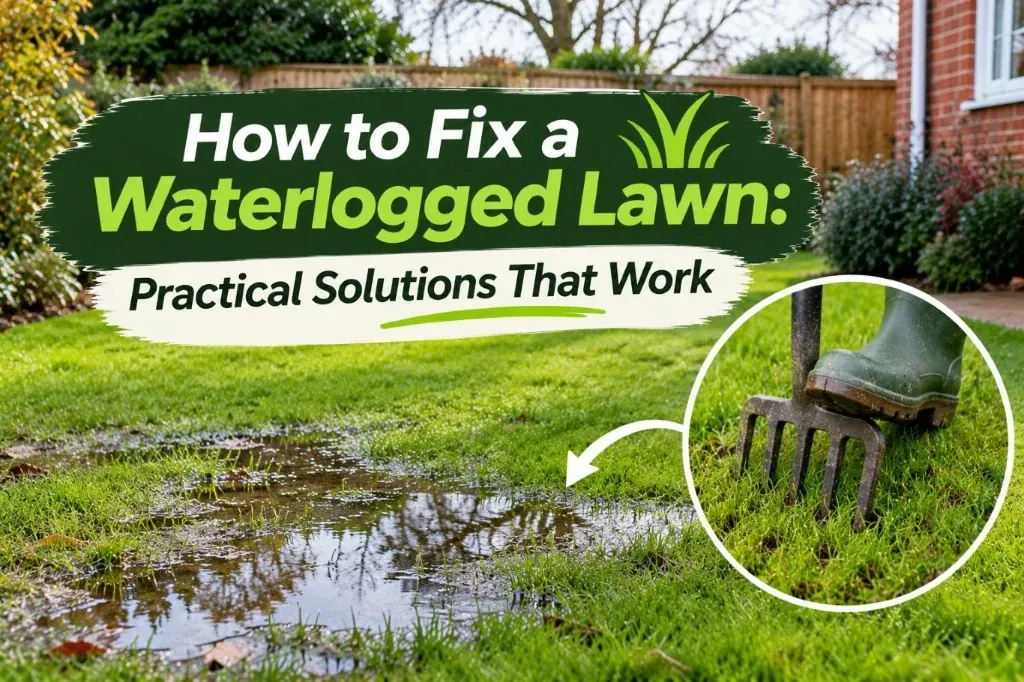
- Aerate Heavy Clay Soils: Before hard frosts set in, spike compacted lawns with a garden fork or hollow-tine tool to a depth of 100mm. This opens vertical channels that allow winter rainwater to drain through the topsoil rather than puddling on the surface.
- Raise Mower Heights for Final Autumn Cuts: Never scalp the lawn going into winter. Keep cutting blades set to 40mm to 50mm to provide thermal insulation for root crowns.
FAQs
1. Should you water your lawn in winter if it hasn’t rained for two weeks?
In the UK, two weeks without rain during winter is rarely a cause for concern. High relative humidity and dense morning dew provide ample moisture for dormant root systems. Only consider watering if the dry spell extends past three to four weeks, strong drying winds are present, and the soil feels completely dry 50mm below the surface.
2. Can I use warm water to melt frost or ice on my lawn?
No, under no circumstances should you pour warm or hot water onto a frosted lawn. The sudden thermal shock disrupts plant cell biology, and as soon as the warm water cools in the ambient air, it will refreeze into a solid, impenetrable sheet of glaze ice that suffocates the grass crowns.
3. How do I tell if my winter lawn is waterlogged?
Walk around the perimeter of the lawn. If the ground squelches audibly underfoot, water pools around your boots, or water remains standing on the surface more than 24 hours after rainfall, the soil profile is waterlogged. Relieve this by hollow-tine aerating and top-dressing with a free-draining sandy loam once the soil dries slightly.
4. Which areas across Essex and London do your delivery vehicles cover?
We operate a regional transport fleet delivering fresh cultivated grass rolls and landscaping supplies across all of Essex, East London, and North London, regularly supplying domestic and commercial projects in Chelmsford, Brentwood, Romford, Chigwell, Epping, Loughton, and Enfield.
5. How quickly can you deliver fresh turf rolls and screened topsoil during winter?
We harvest our turf fresh to order year-round and consistently deliver natural turf rolls, 1-ton bulk bags of screened topsoil, and decorative wood chippings within 24 to 48 hours of order confirmation, subject to ground conditions.
Final Thoughts: Let Nature Handle Your Winter Lawn
When it comes to watering lawn in winter, restraint is almost always the best approach. Cool-season grasses in the UK are well-adapted to endure winter weather, provided they are not stressed by unnecessary human intervention. By letting natural seasonal rainfall keep the soil moist, staying off frosted ground, clearing fallen leaves, and reserving supplemental water strictly for newly laid turf or severe winter droughts, you protect your sward from cold-weather stress. Come spring, your lawn will emerge thick, resilient, and ready for rapid green growth.
When your outdoor space requires farm-fresh grass rolls, free-draining topsoil to combat waterlogging, or full-service ground installation, count on Turf Supplies Essex. Providing top-quality natural turf rolls with delivery & installation services, including landscaping materials like topsoil & wood chippings, our team gives gardens across Essex, East London, and North London the dependable supplies and practical advice needed to look their best in every season. Contact our friendly specialists today to discuss your garden plans or request a fast, competitive quote.