
Quick Summary
- Cool, damp British winters create the perfect breeding ground for destructive winter lawn diseases, including snow mould, fusarium patch, and red thread.
- Most winter grass infections are triggered by poor air circulation, wet thatch blankets, heavy clay waterlogging, and late applications of high-nitrogen fertiliser.
- Timely identification of warning signs—such as bleached circular scars, pinkish cobweb mycellium, or slimy patches—prevents widespread turf crown death.
- Preventative cultural controls like spike aeration, autumn raking, high mowing deck adjustments, and iron-rich feeds stop fungal spores from gaining a foothold.
- Turf Supplies Essex provides top-quality natural grass turf rolls with delivery & installation services, including landscaping materials like topsoil & wood chippings, giving homeowners across Essex, East London, and North London the products and expertise needed to maintain healthy, resilient lawns year-round.
Introduction
Winter brings a prolonged period of environmental stress for British lawns. Between November and February, reduced sunlight, freezing overnight temperatures, and relentless rainfall place cool-season turf grasses under continuous strain. As grass plants slow their metabolic activity and enter dormancy, their natural immune responses weaken. For homeowners across the South East, this damp, stagnant climate provides an open window for virulent winter lawn diseases to take hold. What starts as a small, water-soaked circle can quickly expand into widespread fungal scarring, leaving unsightly bleached voids once the spring thaw arrives. Protecting your turf requires understanding what causes these fungal infections, recognising symptoms early, and applying practical cultural controls before the damage becomes structural. Operating as an established local supplier, Turf Supplies Essex provides top-quality natural grass turf rolls with delivery & installation services, including landscaping materials like topsoil & wood chippings, helping property owners across Essex, East London, and North London safeguard their lawns against harsh winter conditions.
- Quick Summary
- Introduction
- The Winter Microclimate: Why Lawn Fungus Thrives
- Common Winter Lawn Diseases in the UK: How to Identify Them
- 1. Fusarium Patch and Snow Mould ( Microdochium nivale )
- 2. Red Thread ( Laetisaria fuciformis )
- 3. Brown Patches and Winter Dead Spots
- Winter Lawn Disease Prevention: Cultural Strategies
- 1. Clear Surface Water and Relieve Compaction
- 2. Clear Fallen Leaves and Organic Debris
- 3. Switch Away Heavy Morning Dew
- 4. Adjust Autumn Mowing Heights
- 5. Harden Turf with Iron, Not Nitrogen
- How to Treat Lawn Fungus and Restore Damaged Swards
- FAQs Section
- Final Thoughts: Protecting Your Turf for Year-Round Health
Seeing pink cobwebs, slimy patches, or mystery brown circles on your winter lawn? Tap the WhatsApp button to get quick diagnostic and treatment advice from our team :
The Winter Microclimate: Why Lawn Fungus Thrives
Fungal spores exist naturally in every garden soil bed, living harmlessly among decomposing organic matter. They only become active pathogens when specific environmental conditions align:
Persistent surface dew
Cannot repair leaf tissue
choking leaf tissue under snow/water.
- Persistent Leaf Wetness: British winters frequently feature high relative humidity, heavy morning dew, and low cloud cover. When grass blades remain saturated for 48 hours or more, fungal spores germinate directly on the wet leaf cuticle.
- Subsoil Compaction and Clay Waterlogging: Much of Essex and the London basin sits on dense, impermeable clay. Standing pools of surface water push out soil oxygen, turning the root zone anaerobic and suffocating fine root hairs.
- Thick Thatch Blankets: A spongy layer of dead moss, clipped grass, and fallen tree leaves traps humidity against the crown of the plant, creating an insulated incubator for fungal pathogens.
- Incorrect Late-Season Feeding: Applying high-nitrogen fertiliser in late autumn forces tender, lush leaf blades that lack cold hardiness. These soft cells rupture easily in freezing weather, providing an entry point for disease.
Common Winter Lawn Diseases in the UK: How to Identify Them
Spotting and identifying lawn diseases early allows you to intervene before the fungus reaches and destroys the central growing point of the grass plant.
| Disease Name | Visual Symptoms / Mycelium | Typical Conditions |
|---|---|---|
| Fusarium Patch (Snow Mould) (Microdochium nivale) | Small water-soaked spots turning yellow-brown with pink/white web | Wet autumn/winter, high humidity, heavy snowfall or wet thatch |
| Red Thread (Laetisaria fuciformis) | Bleached patches with red, antler-like needles on leaf tips | Mild, wet spells; low nitrogen; compacted, poorly aerated soil |
| Dollar Spot (Clarireedia) | Small, sunken straw-coloured spots (50mm across) with tan halos | High humidity, cool nights, excessive morning dew |
| Leaf Spot & Melting Out (Drechslera poae) | Purple-brown oval lesions on leaves, rotting crowns near soil | Prolonged dampness, cold rain, severely compacted ground |
1. Fusarium Patch and Snow Mould (Microdochium nivale)
This is the most destructive and widespread lawn fungus in winter seen across the UK.
- Early Indicators: It begins as small, water-soaked orange-brown circles roughly 50mm in diameter.
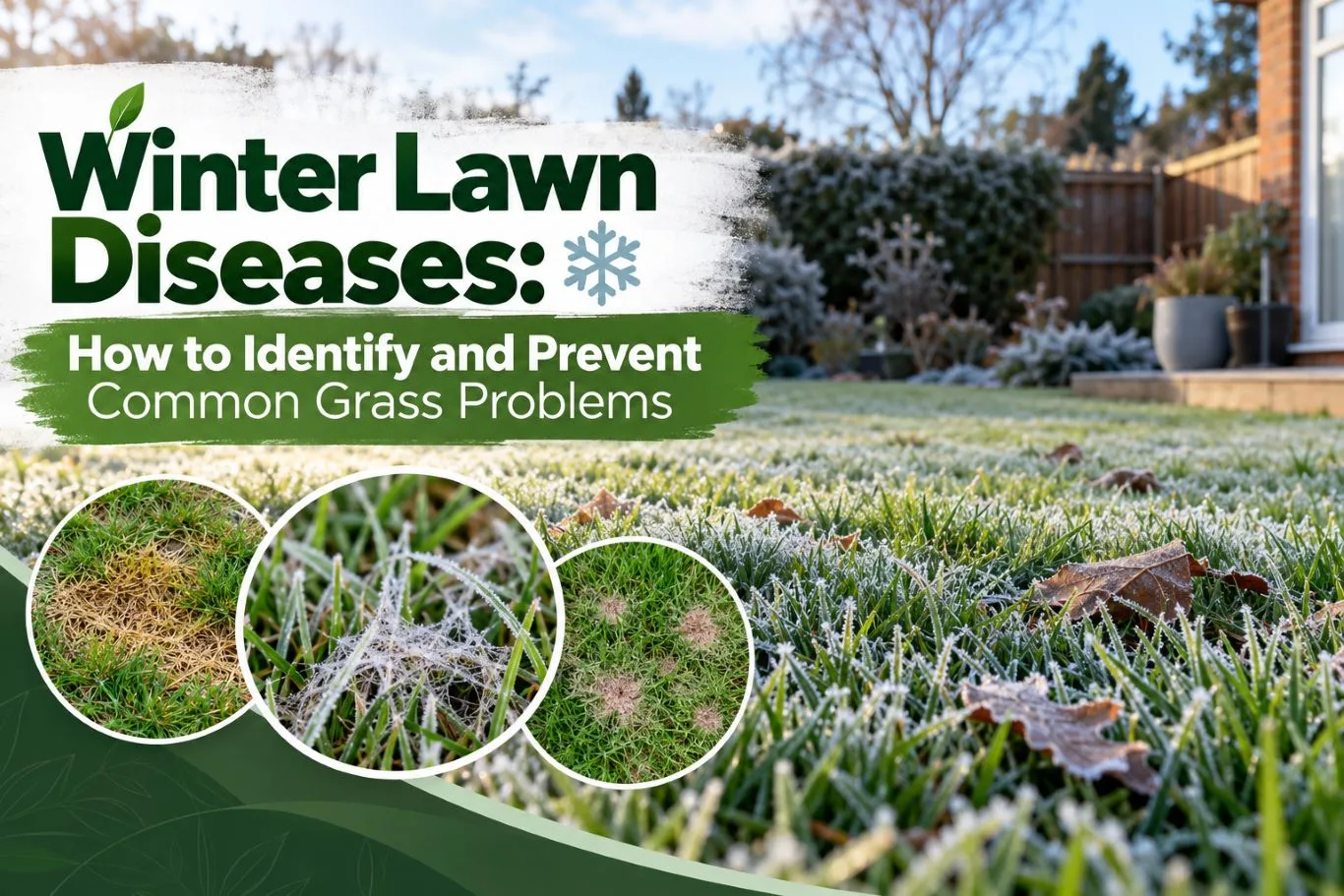
- Advanced Signs: As the disease advances, the patches enlarge up to 300mm across, turning straw-coloured or pale bleached yellow. During calm, humid mornings, you will see a delicate, spiderweb-like white or pale pink fungal growth (mycelium) around the perimeter of the patch.
- Under Snow: When prolonged snow blankets a frosted lawn, this fungus causes true snow mould on grass, leaving slimy, collapsed, dead circles once the snow melts.
2. Red Thread (Laetisaria fuciformis)
While predominantly an autumn complaint, red thread persists through mild UK winters.
- Visual Symptoms: Irregular patches of bleached, ragged turf appear across the lawn. On close inspection, you will spot distinct, pink-to-bright-red needle-like outgrowths (stromata) emerging from the tips of dying grass blades.
- Impact: While unsightly, red thread rarely kills the underlying root crown; it remains a foliar disease that discolours the upper sward.
3. Brown Patches and Winter Dead Spots
Discovering brown patches in the lawn after winter or distinct dead spots in the lawn after winter usually points to root-zone suffocation or localized crown rot. Where standing surface water remained over compacted clay, root tissues drown and turn black, leaving empty soil voids once spring drying begins.
Winter Lawn Disease Prevention: Cultural Strategies
Chemical fungicides for domestic lawns are heavily restricted in the UK, making preventative cultural management your primary line of defence. Applying these frost-resistant lawn care tips and winter lawn disease prevention practices keeps fungal pressure low.
1. Clear Surface Water and Relieve Compaction
Standing puddles create anaerobic root conditions that encourage fungal rot.
- Forking & Aerating: Use a garden fork or mechanical hollow-tiner to punch holes 100mm to 150mm deep across prone hollows. Wiggle the tines gently to shatter compacted subsoil pans and allow trapped water to drain into lower soil strata.
- Dressing with Coarse Materials: On dense clay lawns, brush a mix of sharp sand and screened topsoil into open aeration holes to establish permanent drainage channels.
2. Clear Fallen Leaves and Organic Debris
Never leave a wet carpet of autumn leaves or thick thatch lying over your turf through December and January. Decomposing organic matter starves the grass of light, traps stagnant air, and creates the exact high-humidity microclimate required for fusarium spores to spread. Use a flexible spring-tine rake once a week on dry days.
3. Switch Away Heavy Morning Dew
On mild, windless winter mornings when heavy dew blankets the lawn, sweep the surface with a long switch cane or a soft yard brush. Knocking water droplets off the grass foliage helps the leaves dry out hours earlier, denying fungal spores the continuous film of moisture they need to infect the leaf cuticle.
4. Adjust Autumn Mowing Heights
Heading into winter, gradually raise your lawnmower cutting height to around 40mm to 50mm. Cutting too low (scalping) weakens the plant, limits root depth, and exposes vulnerable crowns to cold, damp air. Taller grass blades capture scarce winter sunlight more effectively while shielding root crowns from frost.
5. Harden Turf with Iron, Not Nitrogen
Avoid applying spring or summer high-nitrogen fertilisers during late autumn and winter. Instead, use a winter-specific lawn tonic containing iron sulphate and potassium. Potassium strengthens cell membranes against sub-zero freezing, while iron acidifies the immediate surface layer slightly, hardening leaf tissues and discouraging moss and fungal germination without stimulating soft foliar growth.
How to Treat Lawn Fungus and Restore Damaged Swards
If your lawn has already fallen victim to winter infections, knowing how to treat lawn fungus effectively ensures a swift recovery once spring arrives.
| Damage Level | Recommended Spring Action |
|---|---|
| Light Foliar Tip Scorch | Gentle spring-tine raking + balanced NPK spring feed |
| Moderate Patchiness (<30%) | Spike aeration, overseeding & 5mm screened topsoil dressing |
| Extensive Crown Death (>40%) | Mechanical turf cutting, rotavating, and fresh turf rolls |
- Isolate and Wait: Do not walk across, rake, or mow infected, active fungal patches during freezing winter weather. Walking through active fusarium patches carries sticky fungal mycelium on your boots, spreading spores across clean areas of the lawn.
- Gently Rake in Early Spring: Once soil temperatures climb above 8°C in March, use a light wire rake to gently comb out dead, matted, straw-coloured grass from scarred spots. This allows warming sunlight and air to reach the soil surface.
- Spike and Overseed: Pierce compacted bare spots with a hand fork, scatter a resilient grass seed mix (incorporating dwarf perennial ryegrass and fescues), and top-dress lightly with 5mm of 10mm Agriculture Screened Premium Grade Top Soil.
- Consider Turf Replacement for Severe Losses: If extensive standing water or virulent snow mould has rotted large sections of the root plate, patching with seed can take months. Laying freshly harvested, weed-free cultivated turf rolls delivers an instant, disease-resistant fix that restores uniform density in weeks.
FAQs Section
1. Can a lawn naturally recover from fusarium patch without chemicals?
Yes. In most cases, fusarium patch only damages the upper leaf foliage. Once spring arrives with warmer temperatures, increased sunlight, and fresh airflow, the disease halts naturally. Applying a balanced spring fertiliser and lightly raking away the dead thatch helps healthy new shoots quickly fill in the bare spots.
2. Why does snow mould appear right after the snow melts from my lawn?
Snow mould develops beneath the snow blanket because the snow acts as an insulator, holding temperatures right around 0°C to 2°C while trapping moisture and blocking light. This dark, humid, and still environment is ideal for Microdochium nivale to grow unchecked.
3. Should I apply a fungicide to treat winter grass problems in my garden?
For domestic UK lawns, chemical fungicides are rarely necessary or readily available over the counter. Cultural management—improving soil drainage, removing autumn leaves, regular aeration, and switching away standing dew—is safer, more cost-effective, and provides long-lasting disease prevention.
4. Which areas across Essex and London do your delivery vehicles cover?
We provide prompt delivery across all of Essex, East London, and North London, regularly supplying domestic gardens and trade sites in Chelmsford, Brentwood, Romford, Chigwell, Epping, Loughton, and Enfield.
5. How quickly can you deliver turf rolls and screened topsoil for spring repair work?
We harvest turf fresh to order and maintain our own local transport fleet, consistently delivering cultivated turf rolls, 1-ton bulk bags of screened topsoil, and natural wood chippings within 24 to 48 hours of order confirmation.
Final Thoughts: Protecting Your Turf for Year-Round Health
Dealing with winter lawn diseases can be frustrating, especially after spending spring and summer building an attractive outdoor space. However, fungal outbreaks are not an inevitable fate. By understanding the conditions that foster fungal growth—such as standing water, compacted clay, thick thatch, and soft leaf tissue—you can take simple, proactive steps to protect your sward through the coldest months. Aerating early, clearing fallen leaves, and staying off frozen ground will ensure your turf emerges in March green, robust, and disease-free.
When your lawn requires fresh turf rolls, rich screened topsoil for repairs, or complete installation services, trust Turf Supplies Essex. Providing top-quality natural grass turf rolls with delivery & installation services, including landscaping materials like topsoil & wood chippings, our local team supplies homeowners and landscaping professionals across Essex, East London, and North London with the high-grade materials and support required for thriving outdoor spaces. Contact our friendly team today to discuss your lawn recovery plans or request a fast, competitive quote for your next project.