
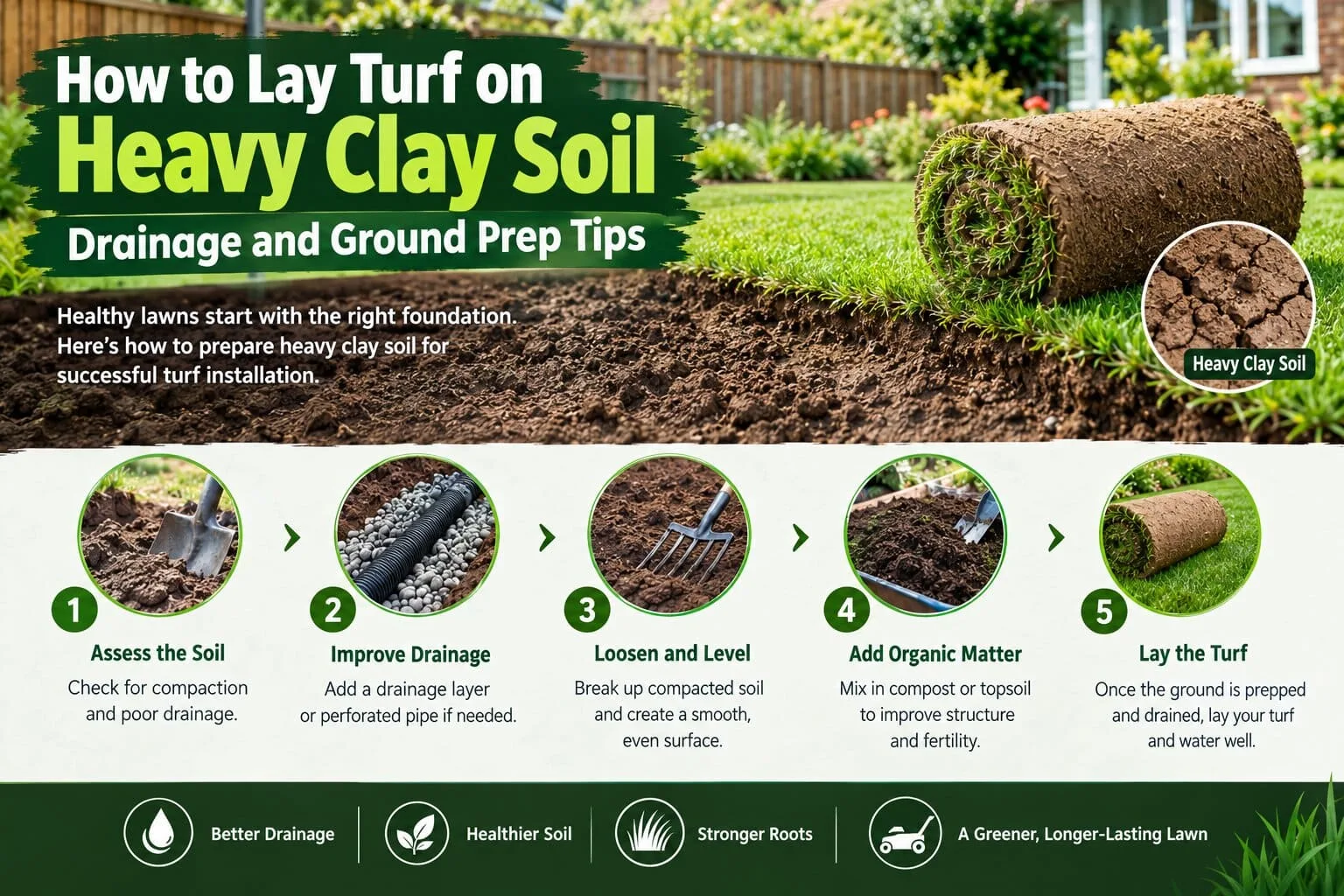
Quick Summary
- Learning how to lay turf on heavy clay soil transforms sticky, waterlogged ground into a vibrant, resilient family lawn.
- Dense clay subsoil requires mechanical decompaction and organic conditioning to break open tight microscopic soil pores.
- Incorporating coarse sand and certified screened loam builds a free-draining seedbed that lets roots breathe.
- Strategic ground grading and subsurface French drains prevent surface water from collecting in low dips after rain.
- Laying high-grade, sun-tolerant turf rolls over properly prepped ground guarantees rapid rooting and long-term drought resilience.
A brand new lawn can turn a tired, uneven garden into a welcoming green sanctuary for children, pets, and weekend entertaining. However, for homeowners tackling properties built over dense clay, installing new grass presents distinct challenges. In winter, untreated ground turns into a squelchy, oxygen-deprived quagmire; in summer, it bakes into rock-hard, cracked ground that rejects water like concrete.
Attempting to lay turf on heavy clay soil in Essex without addressing these underlying physical conditions will quickly cause delicate young roots to suffocate and rot. Success comes down to patient ground preparation, proper drainage cultivation, and selecting farm-fresh turf rolls grown to withstand diverse UK weather.
Homeowners and experienced landscape contractors regularly turn to Turf Supplies Essex for prompt deliveries of screened loam and hardy grass varieties like Essex Premium Sun Turf, knowing that reliable local supplies make all the difference when dealing with challenging ground.
Need expert guidance on decompacting clay pans and building a free-draining rootbed?
Tap the button below to message our team on WhatsApp for a fast, no-obligation quote on our ground prep services and premium turf supplies..!
The Natural Mechanics of Heavy Clay Soil
To build a lawn that stays healthy through wet winters and dry summers, it helps to understand how clay soil behaves.
Clay is not inherently poor earth. In fact, from a nutritional standpoint, clay is packed with essential minerals, trace elements, and plant nutrients that sandy soils lose through natural leaching. The issue lies entirely within its physical structure:
- Microscopic Particle Platelets: Clay particles are microscopic and flat, fitting tightly against each other with almost no natural airspace between them.
- Slow Subsoil Percolation: Because pore spaces are tiny, gravitational water filters downward at a snail’s pace, leaving the rootzone saturated for days after ordinary rainfall.
- Surface Compaction: Foot traffic, wheelbarrows, garden furniture, and building work press remaining air pockets out of clay, turning the upper profile into an impenetrable shelf.
- Seasonal Expansion and Contraction: Wet clay swells and forms sticky mud, while summer drought causes it to shrink, pull apart, and form deep vertical cracks that shear young root systems.
Laying fresh turf rolls directly on top of uncultivated clay traps these structural problems beneath your new lawn. The roots cannot push down, water cannot drain away, and moss inevitably takes over within a few seasons.
Step 1: Evaluating Your Garden Drainage and Slope
Before hiring machinery or ordering fresh materials, assess how water moves across your plot.
Conducting a Percolation Test
Dig three test holes across your proposed lawn area, roughly thirty centimetres deep and thirty centimetres wide. Fill each hole with water and allow it to drain away completely to saturate the subsoil. Fill the holes a second time and measure how quickly the water level drops with a ruler:
- Good Drainage: The water level drops by twenty-five millimetres or more per hour. Standard cultivation and topsoil blending will be sufficient.
- Moderate Drainage: The water level falls between ten and twenty-five millimetres per hour. Soil aeration, coarse grit, and a deeper topsoil bed are required.
- Poor Drainage: The water takes over twelve hours to empty. Subsurface drainage pipes or gravel French drains must be installed before laying grass.
Establishing the Natural Fall Line
Every garden should carry a subtle, natural fall of approximately one in eighty falling away from the house, patio, and outbuildings. This ensures sudden storm runoff moves gently toward planted borders or drainage soakaways rather than pooling against your property’s brickwork.
Step 2: Clearing Surface Vegetation and Weeds
Never lay fresh grass rolls over an existing, patchy lawn or established perennial weeds. Weeds like dandelions, couch grass, and bindweed will push straight up through the seams of new turf, while buried green matter rots unevenly, causing soft dips.
Use a flat-bladed spade or hire a mechanical turf cutter to shave off the existing grass and weed roots at a depth of twenty to twenty-five millimetres. Cart the old sod away to a compost heap or skip.
Once cleared, walk the bare earth to remove large flints, building rubble, tree roots, and buried rubbish that could obstruct your tools or stunt root growth later.
Step 3: Decompacting and Breaking Up Clay Soil
Loosening compacted clay is the most physically demanding part of preparing clay soil for turf, but it is also the step that guarantees long-term success.
The subsoil must be decompacted to a working depth of at least one hundred and fifty to two hundred millimetres:
- Small Plots: Drive a heavy digging fork into the earth every fifteen centimetres and lever the handle backwards to open deep fissures within the clay pan.
- Medium to Large Gardens: Hiring a petrol rotary cultivator makes the work much more efficient.
Timing is critical when rotavating clay soil for lawn preparation. Never rotavate clay when it is soaking wet, as the churning blades will smear the subsoil into dense, sticky clods that dry like concrete bricks.
Equally, attempting to cultivate bone-dry clay will rattle the machinery without penetrating the surface. Aim for damp, crumbly ground. If the weather has been dry, lightly sprinkle the ground with a hose the evening before to soften the soil structure.
Step 4: Installing Effective Subsurface Drainage
If your percolation test showed poor drainage, or if water naturally pools in low hollows, you must introduce dedicated drainage channels before importing your topsoil.
Focus on improving clay soil drainage lawn areas by digging a simple French drain network in a herringbone pattern across the garden. Dig trenches thirty centimetres wide and forty centimetres deep, sloping gently toward an open gravel soakaway situated at least five metres away from any building foundations.
Line the trenches with a non-woven permeable geotextile membrane to keep fine clay particles from washing into the stone. Place eighty to one hundred millimetre perforated plastic land drainage coil along the trench floor, backfill with clean, washed ten-to-twenty millimetre pea shingle, and fold the fabric neatly over the top. This provides an unobstructed subterranean path for groundwater to escape during winter downpours.
Step 5: Incorporating Sand, Grit, and Organic Matter
Once your drainage trenches are backfilled, turn your attention to modifying the native clay itself.
Clay particles need coarse, angular elements introduced into their structure to create permanent air channels. Spreading a generous layer of sharp sand for clay lawn improvement across the cultivated ground—roughly twenty to thirty kilograms per square metre—creates open pockets where roots can breathe.
Always use coarse, washed horticultural sharp sand or coarse grit; never use soft builder’s sand, which contains fine round particles that mix with clay to create an even denser, mortar-like consistency.
Alongside sharp sand, blend in well-rotted organic compost, leaf mould, or spent mushroom compost. Organic matter feeds beneficial earthworms and soil microbes, whose natural activity helps bind tiny clay platelets into crumbly, friable soil crumbs.
Step 6: Capping with Screened Topsoil for the Rootbed
While conditioning native clay improves deep drainage, grass roots need a receptive, weed-free bed of soil to establish without stress.
Spreading a high-quality topsoil for clay soil turf installations creates a protective fifty to seventy-five millimetre buffer between your lawn and the heavy subsoil beneath.
Use certified, screened sandy loam topsoil containing a balanced ratio of sand, silt, and natural organic matter. This screened layer acts like a sponge, holding just enough moisture and fertility for root development while allowing excess rainwater to percolate down into the conditioned clay and drainage runs below.
Using this balanced approach ensures that learning how to lay turf on heavy clay soil for UK gardens yields a thick, level, and hard-wearing lawn that stands up to family life through every season.
Step 7: Levelling, Heel-Packing, and Screeding
Achieving a flat, firm seedbed prevents mower scalping and eliminates minor hollows where standing water can collect.
- Rough Raking: Use a wide landscaping rake to spread your screened topsoil evenly across the plot, pulling soil from high mounds into low dips.
- The Heel-Packing Method: Never leave soil light and fluffy. Walking across the soil with small, overlapping steps—concentrating your body weight entirely on your heels—compresses hidden air pockets beneath the surface.
- Checking with a Straight Edge: Place a long aluminium screed bar or straight timber plank over the soil with a spirit level on top. Rotate the timber across the ground in multiple directions. Fill low dips where daylight shows beneath the plank, and scrape down high humps.
- Final Tilth and Feed: Lightly rake the firm surface in two directions to create a crumbly tilth fifteen millimetres deep. Lightly scatter a balanced pre-turf starter fertiliser rich in phosphorus to give establishing roots an immediate boost.
Step 8: Selecting and Laying Your Lawn Turf
With ground preparation complete, your living grass rolls can be unrolled without delay.
Sourcing rolls through established lawn turf suppliers essex ensures that the turf is cut fresh from local nursery fields within twenty-four hours of arriving at your driveway, minimising pallet heat stress.
For clay gardens that experience harsh summer drying and intense sun, consider selecting Essex Premium Sun Turf. This premium cultivar blend combines deep-rooting tall fescues with resilient perennial ryegrass.
Its root architecture pushes down into the loosened clay subsoil, anchoring the sod securely and drawing up subterranean water long after shallow-rooted grass has wilted.
When you begin turf laying essex gardens, follow these best practices:
- Start laying against a straight boundary, such as a paved patio or tidy timber gravel board.
- Unroll each strip carefully, butting the edges and ends tightly together without overlapping or stretching the turf.
- Stagger the joints in subsequent rows in a brickwork pattern to prevent long, exposed seams.
- Always work from wooden scaffold boards laid across the turf you have just put down. Walking directly on unrooted turf leaves deep foot impressions in your freshly graded topsoil.
- Trim edges neatly using a sharp half-moon lawn edger or utility blade.
Ongoing Watering and Aftercare
Aftercare is just as important as ground preparation, especially over dense subsoil:
- The Initial Drench: Immediately after laying, soak the new lawn thoroughly. Gently lift a corner roll to check that water has penetrated through the turf mat into the topsoil below.
- First Fortnight: Water once daily during dry weather, preferably early in the morning so the grass blades dry off during the day, avoiding evening fungal infections. Keep the soil damp, but avoid saturating the ground to the point of run-off.
- First Cut: Once the grass reaches roughly seventy-five millimetres and cannot be lifted by hand, give it its first cut with your mower blades on their highest setting, taking off no more than the top third of the leaf blade.
Frequently Asked Questions
Can I lay fresh turf straight over hard clay without topsoil?
Laying turf straight onto raw clay is not recommended. Young roots struggle to penetrate compacted clay, and during dry spells, the clay will shrink and tear the sod. Adding a fifty to seventy-five millimetre bed of screened topsoil gives roots the loose, nutrient-rich environment they need to establish quickly.
Will rotavating clay soil cause problems?
Rotavating is safe and effective as long as the clay is damp and crumbly. Rotavating saturated clay causes the soil to smear and bake into hard clods, while dry clay will damage machinery.
How quickly can you deliver fresh turf and topsoil across Essex?
Turf Supplies Essex provides prompt delivery throughout the working week, typically fulfilling orders within twenty-four to forty-eight hours of booking. This fast turnaround ensures that grass rolls spend minimal time on pallets and arrive cool, hydrated, and ready to lay.
Which locations are covered by your turf delivery vehicles?
Deliveries run across the whole of Essex and surrounding areas, including Chelmsford, Brentwood, Southend, Rayleigh, Billericay, Basildon, Colchester, and nearby London commuter towns, with crane offloading straight to your driveway or kerbside.
How do I stop my clay soil lawn from turning into a bog in winter?
A combination of mechanical aeration, blending sharp sand into the subsoil, and installing a gravel French drain system will keep groundwater moving away from your rootbed throughout the wet winter months.
Final Thoughts & Next Steps
Tackling heavy clay soil takes some physical groundwork, but the results are well worth the effort. By breaking up compacted earth, installing practical drainage trenches, and creating a porous rootbed with screened topsoil, you give your new lawn the best possible start in life.
If you are planning your garden makeover and searching for certified topsoil suppliers near me, using high-grade screened loam guarantees a stone-free, level bed. Sourcing experienced professionals for turf laying services near me takes the hard labour out of rotavating and screeding. Arranging reliable turf delivery near me ensures that fresh, healthy turf rolls arrive at your property on the exact morning you are ready to install them.
For property owners preparing to lay turf on heavy clay soil in Essex, Turf Supplies Essex remains your trusted, affordable, and professional local specialist. Providing farm-fresh rolls of resilient Essex Premium Sun Turf alongside certified topsoil solutions, their friendly team delivers the quality materials and practical guidance you need to create a lush, perfectly drained lawn that thrives year after year.