Quick Summary
- Anyone wondering how long does turf take to root in winter can typically expect the process to take between 4 to 8 weeks in the UK, compared to just 2 to 3 weeks during mild spring or autumn weather.
- Cool soil temperatures slow above-ground foliar growth, allowing the grass plant to direct its biological energy downward into developing fine, white root anchors whenever the ground is above freezing.
- Winter turfing eliminates drought stress and intense hosepipe watering schedules, but requires patience before foot traffic or garden furniture can be allowed on the lawn.
- Performing a gentle “tug test” on the edge of an unrolled strip is the most reliable way to check for established subterranean root knitted plates without disturbing the sward.
- Turf Supplies Essex provides top-quality natural turf rolls with delivery & installation services, including landscaping materials like topsoil & wood chippings, supplying residential and trade projects across Essex, East London, and North London with hardy, winter-ready lawns.
Introduction
Laying a fresh lawn during the colder months is one of the most practical landscaping decisions a homeowner can make, yet it often brings an element of uncertainty. In the height of summer or early autumn, new rolls burst into life within days, showing rapid vertical growth that demands regular mowing. In the depths of a British December or January, however, the landscape appears completely still. This stillness leads many to ask: how long does turf take to root in winter, and is anything actually happening beneath the surface? The answer lies in the subterranean biology of cool-season turf grasses. While frosty mornings cause visible foliage to pause, the root systems beneath continue to slowly branch into the prepared loam. As an established regional supplier, Turf Supplies Essex provides top-quality natural turf rolls with delivery & installation services, including landscaping materials like topsoil & wood chippings, helping gardens throughout Essex, East London, and North London achieve strong, durable root establishment through every winter season.
- Quick Summary
- The Biological Timeline: Winter Rooting vs Warm-Season Rooting
- Key Factors Affecting Turf Root Growth in Cold Weather
- 1. Soil Temperature at Root Depth
- 2. Physical Subsoil Preparation
- 3. Intimate Soil Contact
- Clear Signs of Turf Rooting: The “Tug Test”
- How to Help Turf Root in Cold Weather: Practical Aftercare
- 1. Manage Hydration Accurately
- 2. Keep All Foot Traffic Off the Sward
- 3. Clear Leaves Weekly
- 4. Delay the First Mowing Until Spring
- When to Call the Professionals
- FAQs Section
- Final Thoughts: The Secret to an Effortless Spring Lawn
Unsure whether your newly laid winter turf has anchored into the subsoil? Tap the WhatsApp button to get quick, expert root-check and aftercare advice from our Essex team :
The Biological Timeline: Winter Rooting vs Warm-Season Rooting
The metabolic rate of turf grass is governed by soil temperature rather than daytime air temperatures. Understanding how long does new turf take to establish in winter requires looking at the calendar through an agronomic lens.
Day 1
Initial Hydration
Day 7–10
White Roots Appear
Day 14–21
Complete Root Knit
Week 1–2
Foliage Dormant
Week 3–5
Fine Hair Migration
Week 6–8
Deep Plate Anchorage
- Spring and Autumn (2–3 Weeks): Warm soil (10°C to 15°C) and consistent moisture trigger rapid cellular division. Primary root anchors push into the topsoil within 5 to 7 days, and rolls are fully knitted within 14 to 21 days.
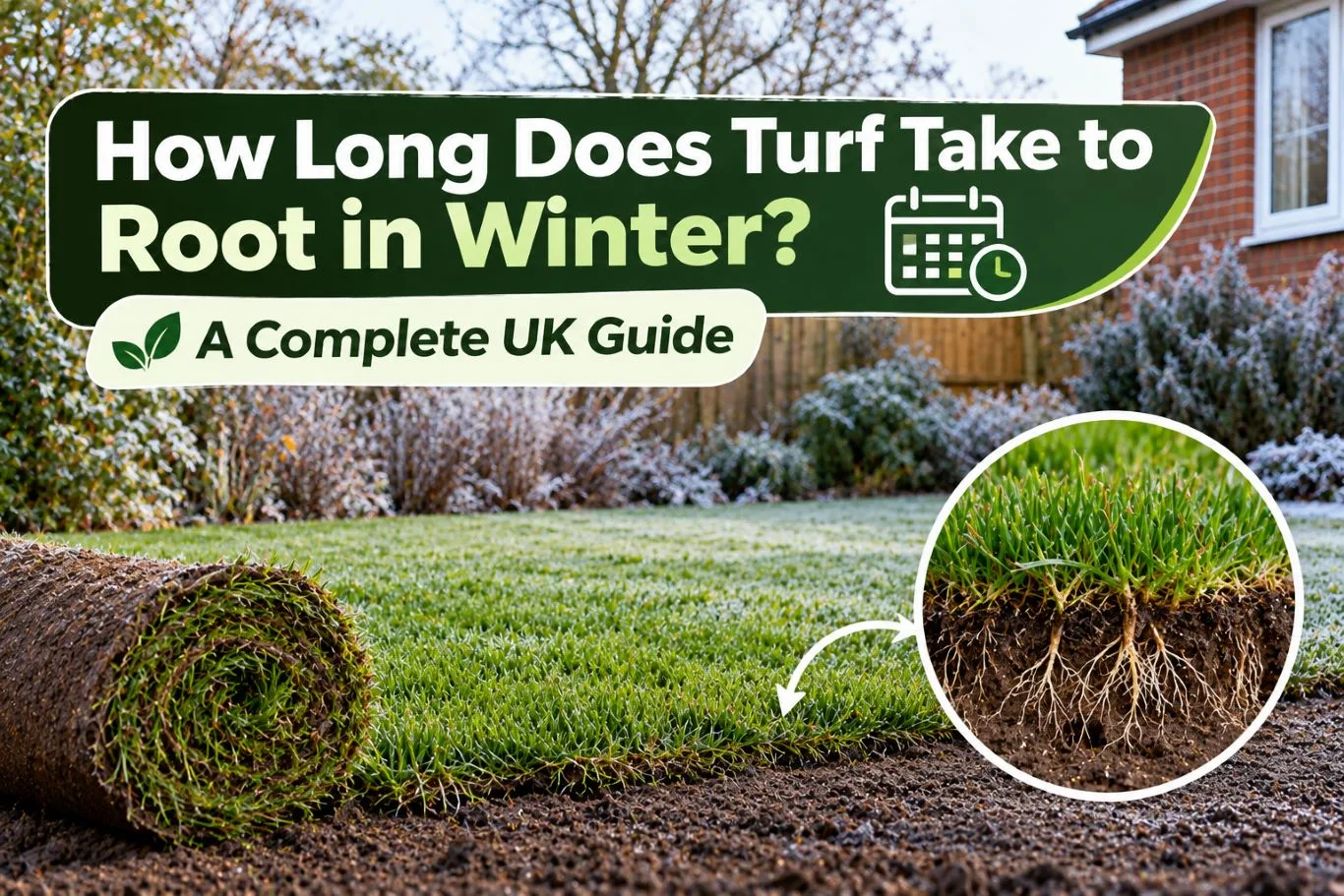
- Winter (4–8 Weeks): When soil temperatures drop into the 2°C to 7°C range, top-growth stops almost entirely as the plant enters winter dormancy. However, subterranean soil retains latent warmth. Fine, translucent feeder root hairs gradually venture out from the turf base to search for moisture and anchor points. While the winter turf rooting time is extended, the resulting root network is remarkably strong, having developed without the stress of intense sunlight or dry winds.
Key Factors Affecting Turf Root Growth in Cold Weather
Not all winter weeks are identical. Several environmental and structural factors affecting turf root growth dictate whether your lawn knits closer to the 4-week mark or takes the full 8 weeks:
| Growth Factor | Cold-Weather Impact | Optimal Condition |
|---|---|---|
| Soil Temperature | Subsoil below 0°C pauses cell division entirely | Steady 3°C to 7°C range in top 50mm of soil profile |
| Soil Texture & Compaction | Dense, unworked clay blocks air and suffocates tender root hairs | Loosely rotavated sandy loam with high macroporosity (BS3882 grade) |
| Soil-to-Turf Contact | Air pockets underneath rolls dry out root plates and stop knitting | Consolidated, firm tilth rolled with staggered, tight seams |
| Light Exposure & Thatch | Wet leaves block winter light and breed cold fungal pathogens | Clean, debris-free canopy open to all available low-angle sunlight |
1. Soil Temperature at Root Depth
While frost may crust the upper 5mm of grass blades overnight, the soil 50mm to 100mm beneath remains insulated. Root cell division continues at a reduced rate until the ground freezes solid. An extended mild spell during December or January can trigger a burst of root activity.
2. Physical Subsoil Preparation
Roots take the path of least resistance. If fresh turf is unrolled over compacted London clay, new roots cannot easily penetrate the dense subgrade. Thoroughly cultivating the earth to a depth of 150mm and blending in high-quality, screened topsoil creates the loose, aerated channels that delicate roots need to anchor quickly.
3. Intimate Soil Contact
Roots cannot bridge air gaps. If the prepared seedbed is bumpy or left lumpy, sections of the turf backing will hang suspended above the earth. This causes the exposed roots to dry out and die from cold desiccation. Lightly treading or rolling the rolls into flat, direct contact with the prepared loam is essential.
Clear Signs of Turf Rooting: The “Tug Test”
Because you cannot visibly monitor progress beneath the sward, home gardeners often struggle to identify whether their lawn is taking hold. Recognizing the true signs of turf rooting is simple once you know what to test.
• Underside looks unchanged
• Continue leaving undisturbed
• White root strands established
• Lawn safely anchoring
- The Gentle Corner Tug: Choose an unobtrusive edge or corner of a roll. Grip a few blades of grass firmly between your fingers and lift gently upward.
- Reading the Response: If the sod lifts away from the soil with no resistance, root anchorage has not yet begun. If you feel firm downward tension and the sod resists being lifted, the fine root system has successfully knitted into your subsoil.
- Checking the Underside: If an unanchored roll is lifted during week two or three, you will often spot fresh, pearlescent-white root nodes emerging from the black soil backing. These white tendrils are healthy new anchors; handle them delicately and press the turf straight back down.
How to Help Turf Root in Cold Weather: Practical Aftercare
Following proven winter turf aftercare tips accelerates winter lawn establishment and prevents winter weather damage:
1. Manage Hydration Accurately
Proper watering new turf in winter is fundamentally different from summer lawn care. The rolls require one deep, thorough soaking immediately after installation to eliminate air voids and press the root bed against the topsoil. After this initial drink, the UK’s natural rainfall, low evaporation rates, and heavy morning dews will keep the sward moist. Avoid running sprinklers over winter, as saturated soil can turn anaerobic and rot young roots.
2. Keep All Foot Traffic Off the Sward
One of the most critical questions property owners ask is: when can you walk on new turf? In summer, light traffic is safe after two to three weeks. In winter, you should avoid walking on the grass for at least 6 to 8 weeks. Saturated winter subsoils are soft; heavy footsteps sink into the ground, crushing fragile roots and creating permanent, uneven hollows that collect standing puddles.
3. Clear Leaves Weekly
Fallen autumn leaves that sit on newly laid winter turf starve the dormant blades of sunlight. Decomposing foliage traps stagnant humidity against the crowns, inviting fungal infections such as fusarium patch or pink snow mould. Use a light spring-tine wire rake or leaf blower to clear debris on dry days.
4. Delay the First Mowing Until Spring
Do not run a lawnmower across winter-installed turf. Because top-growth is suspended, the blades do not require cutting. Mowing on soft, wet winter ground will smear the soil surface, tear anchoring roots, and damage plant crowns. Store the mower away until March or April, when the grass shows steady vertical growth.
When to Call the Professionals
While DIY winter turfing is achievable with careful planning, navigating heavy, wet clay subsoils and short daylight hours can prove challenging. For complex gardens or large areas, our professional turf laying services across Essex, East London & North London ensure every step is handled by experienced tradespeople. From ground excavation and laser-levelling to supplying rich, BS3882-compliant topsoil and precision turf laying from boards, professional installation ensures rapid, dependable root anchorage regardless of the weather.
FAQs Section
1. What happens if it snows on newly laid winter turf?
Snow will not kill newly laid turf rolls. A light covering of snow actually acts as an insulating blanket, shielding the grass blades and root zone from biting, sub-zero winds. Simply leave the snow to melt naturally; do not shovel it off, and never walk across the snow-covered lawn, as compacting snow into ice suffocates the grass underneath.
2. Will freezing temperatures kill newly laid turf roots?
Healthy, farm-cultivated turf rolls are naturally cold-hardy. While severe ground frost pauses root development, it rarely kills the plant. As soon as temperatures climb above freezing, the root system resumes cellular growth. The only danger is laying turf directly on top of pre-frozen ground, which prevents roots from making soil contact.
3. Why are the roots on my winter turf white?
Fresh, pearlescent-white roots are the best indicator of active root health. They prove that the plant is generating new root tissue and pushing into the topsoil. If roots turn dark brown, mushy, or smell sour, the ground is waterlogged and lacking oxygen.
4. Which areas do your delivery vehicles cover across Essex and London?
We operate a regional fleet providing scheduled, fresh delivery across all of Essex, East London, and North London. Our drivers deliver to residential properties, trade sites, and commercial grounds in Chelmsford, Brentwood, Romford, Chigwell, Epping, Loughton, and Enfield, alongside extended delivery routes to Suffolk, Cambridge, Hertfordshire, and Ipswich.
5. How quickly can you deliver fresh turf rolls and screened topsoil in winter?
Because we cut our cultivated grass rolls fresh to order, we deliver turf rolls, 1-ton bulk bags of screened topsoil, and decorative wood chippings within 24 to 48 hours of order confirmation, subject to ground and weather conditions.
Final Thoughts: The Secret to an Effortless Spring Lawn
Understanding how long does turf take to root in winter gives homeowners the confidence to carry out lawn installations during the quietest months of the gardening calendar. While cold-weather rooting takes a few weeks longer than warm-season laying, the biological benefits—steady root anchorage, consistent natural moisture, and zero risk of summer heat scorch—make winter installations an exceptional investment. By preparing a loose, well-drained soil bed, keeping foot traffic off the sward, and letting nature handle the watering, you will be rewarded with a fully established, deep-rooting lawn that hits the ground running the moment spring arrives.
When you are ready to transform your garden, rely on Turf Supplies Essex. As your local provider of top-quality natural turf rolls with delivery & installation services, including landscaping materials like topsoil & wood chippings, our team combines quality, freshly cut cultivated rolls with decades of regional expertise.
Contact our team today to discuss your winter landscaping plans or receive a fast, competitive quote for your property :